Highlights:
- Hesitation isn’t resistance. It’s often a sign your people care, and it’s worth working with rather than around.
- Access is just the starting line. Real adoption shows up in how people work, not in how many licenses you’ve handed out.
- One-size training rarely fits. The more roles and locations you have, the more your approach needs to flex.
- AI adoption is a people project. The tools matter, but trust, patience and pacing are what make it stick.
When people ask me about AI adoption, they usually expect to talk about tools, features, and rollout timelines. Those things matter. But most of my work is about people. I pay attention to what happens when employees try to use AI in their actual roles, where they feel confident, and where they need support.
That challenge grows when teams are spread across locations. A franchise system, a multi-location healthcare group, or a dealer network might share one brand, but employees have different responsibilities and different levels of comfort with AI. What works at corporate does not automatically work for every local team.
Here’s what I’ve learned so far about making adoption stick.
Hesitation Is Natural
Hesitation is often mistaken for resistance. In my experience, it usually comes from uncertainty about risk or value. Employees have legitimate questions about privacy, output quality, and what AI might mean for their roles. Telling someone to be careful with client information is not very helpful if they have never been shown what a privacy mistake could look like.
For someone who has spent decades building expertise, hearing that a tool can do part of their job can feel like starting over. That deserves patience, not another pep talk. People need room to practice and clear boundaries for what is safe to try. As their judgment develops, confidence can follow.
For teams working across locations, there is also brand risk. A local marketer may worry about publishing something that does not sound like the brand or is not right for their community. Locking down every experiment is not the only answer. Clear brand guidelines, examples, and a sensible review process give local teams a safer place to start. The same balance between oversight and local flexibility matters in a local marketing platform rollout.
Adoption Goes Beyond Access
Handing out licenses is worth celebrating. It is a real first step, and early curiosity matters. But access alone does not give someone confidence, judgment, or time to practice.
Employees still have to work out where AI fits in their day, what they can safely ask it to do, and whether the result is good enough to use. I would rather see one person use AI well in a weekly workflow than see a hundred people try one clever demo and never return to it.
For me, adoption starts to take shape when people repeat a useful workflow, learn from the results, and can explain what has improved. Until then, much of the activity is still experimentation.
Before asking a team to scale its use of AI, it helps to understand what it is ready for. An AI readiness assessment framework can help uncover differences in workflows, training, and governance across departments.
Training Should Be Role Specific
Early in my role as Ironmark’s AI Adoption Manager, I was excited to show people what different features could do. I learned quickly that a feature demonstration did not always help someone get through their own work. A tool that makes one person’s day easier may have little value for someone else.
Now I think about training in terms of workflows. What is the person trying to accomplish? What would a good result look like? How will they check it? I want someone to leave a session with a useful template or process, not just a list of buttons to remember. That is part of operationalizing AI in marketing by turning promising demonstrations into repeatable work.
I have also learned not to rush to teach every new feature as soon as it launches. Sometimes I am still learning where it works well and where it falls short. A little time to test it makes the next training session more useful.
In a multi-location organization, those differences are even more obvious. A regional marketing director, a busy location manager, and a franchise owner writing their own social captions may all work in marketing, but their jobs are not the same. One generic prompt or training deck rarely gives each person what they need.
An AI Rollout Is Not Just Another Software Rollout
People sometimes ask whether adopting AI is really different from introducing another system, like a CRM. There is overlap, of course. Both require training and changes in how people work. But generative AI brings more open-ended decisions into everyday tasks.
With many software tools, you learn a defined process. With AI, you also have to decide how to frame the question, what context to include, and whether the response is reliable enough to use. That judgment takes practice. Sometimes the workflow itself needs to change before AI fits into it.
I have seen training material become outdated before I finished delivering it. That is one reason I do not treat adoption as a single launch event. People need refreshers, time to experiment, and opportunities to talk about what is and is not working.
There is also a personal side to it. If a tool can perform part of a task someone has spent years mastering, it can raise questions about the value of their expertise. I think it is worth acknowledging those concerns rather than assuming another demonstration will resolve them.
Staying Reasonably Up to Date
People ask me how I keep up when the technology changes so quickly. The short answer is that I do not try to know everything. I tell the people I train that, too. It helps to hear that even someone who spends a lot of time with these tools is still learning.
I follow a daily AI news roundup, a few Slack communities, and people I trust on LinkedIn. Mostly, though, I concentrate on the tools our organization actually uses. If we introduce a tool today, I want to revisit it a couple of months later. Otherwise, people can find themselves working from instructions that have quietly gone out of date.
The Biggest Surprise
The biggest surprise for me has been how much I enjoy working with the people who are least comfortable with AI. It can be slow. Sometimes a session begins with helping someone share a screen or log in. But that time matters. You cannot build confidence if someone is afraid to ask the most basic question.
Even experienced users benefit from going back to the basics. I am not trying to get everyone to the newest feature as quickly as possible. I want people to be comfortable enough to use what they have learned again next week.
Proof of Adoption
How do we know when experimentation has become adoption? I look beyond licenses and login activity to five indicators. They are capability, behavior, integration, outcomes, and guardrails.
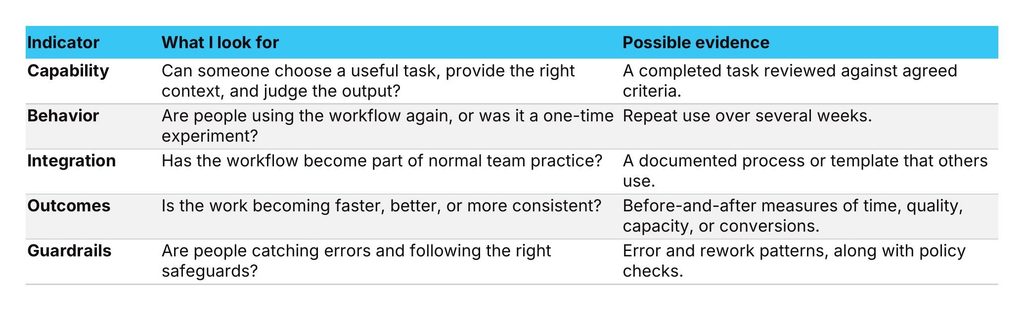
These indicators tell different parts of the story. Someone may use AI often without getting better results. A faster process is not necessarily a safer one. I want to know whether the work has genuinely improved.
That thinking is behind our AI Champions initiative at Ironmark. We want people to document the workflows that help them and put real measures behind the improvements, rather than stop at saying the team has access to AI.
For a multi-location brand, this also creates a way to share good ideas. If one location develops a useful workflow that improves response time or makes a promotion easier to deliver, other locations should be able to learn from it. Consistent measurement helps turn a good local idea into something the wider organization can use.
What Comes Next
None of this is about rushing everyone to the frontier of what AI can do. It’s about giving people the context, the examples, and the space they need to build something real with it — a workflow they trust, that they can explain, and that actually makes their work easier. That’s the adoption that lasts, and it’s the only kind worth measuring.
If you’re leading marketing for a multi-location brand, that same principle just has to stretch further: across regions, roles, and comfort levels, without losing brand consistency along the way. It’s slower than a single company-wide announcement, but it’s the difference between AI that looks good in a rollout plan and AI that truly changes how your locations work.