Highlights:
- An AI readiness assessment framework is not a pass-or-fail test. Organizations often progress at different speeds across people, processes, governance, tools, and measurement.
- Tools and training don’t automatically equal adoption. Real progress happens when AI becomes part of documented, repeatable workflows.
- Measure impact early. Establish baselines for time savings, quality, productivity, and business outcomes so you can demonstrate AI’s value.
- The goal is strategic, human-led adoption. Successful organizations combine experimentation with governance, employee support, measurable results, and workflows designed to create lasting business value.
Everyone wants to know the same thing right now. Are we behind on AI? This is a fair question. Every week brings another tool, another breakthrough, another headline about a company using AI to rewrite workflows, reimagine teams, and possibly save millions of dollars (or at least a few hours).
Meanwhile, your reality may look slightly less cinematic. A few employees are using ChatGPT with relative success every day. A power user has built a prompt library that may or may not be gaining traction. Leadership has requested an AI strategy. IT wants governance. Everyone demands clarity. And you’re trying to figure out whether your marketing team is actually ready for AI, or just very aware that AI exists.
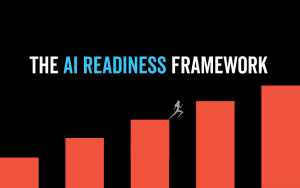
Here’s the good news: AI readiness is not a pass-or-fail test or a checklist, but rather a maturity curve. Most organizations are ahead in some areas and behind in others. It’s very possible for you to have engaged employees but have weak governance, strong tools but little measurement, or leadership buy-in but no operational plan.
Don’t panic. Identify your strong suits, take note of the biggest gap, and decide what to do next using this AI readiness assessment framework.
Related: What’s Changing in Marketing in 2026, and How to Operationalize It
The Five Stages OF AI Readiness
As an AI adoption professional with five years in the field, I outlined this diagnostic framework using my own experience with spearheading Ironmark’s AI training and implementation and witnessing workflow transformation.
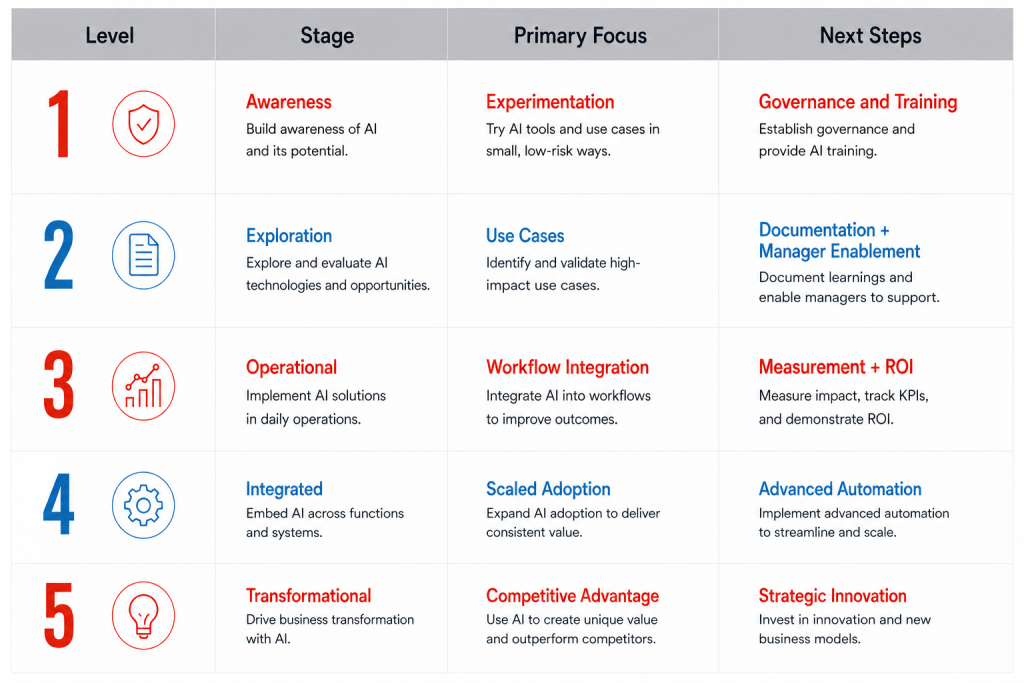
This is my takeaway: organizations typically move through five broad stages of AI maturity, and the path is not always perfectly linear. A practical AI readiness assessment framework helps you look across people, processes, data, governance, tools, and culture, so you can see where your organization is strong, where it is exposed, and what needs attention. Address these and watch how AI implementation in business transforms your company.
Level 1: Awareness
Solo, Fragmented Experimentation→Build Basic Governance and Training
At this stage, AI adoption is mostly individual.
People are experimenting on their own. They are rewriting emails, brainstorming headlines, summarizing meeting notes, or asking ChatGPT to make something sound “more strategic.” Company-wide standards, governance frameworks, or consistent trainings have not been implemented yet. And while this may look like nothing is happening, it just means that the activity is unstructured.
The next step is to create visibility with a light AI readiness audit. Ask: Which tools are people using? What are they using them for? What practices feel safe, useful, risky, or unclear? This gives leaders an honest starting point before they build policies, training, or broader adoption plans.
From there, you need basic training and acceptable use guidelines. This does not mean that you need to draft a 74-page AI constitution. Just design enough structure to help people understand what is allowed, what is not, and where to go when they are unsure.
Level 2: Exploration
You Have Basic Training/Licenses→Document Use Cases and Support Managers
When you’re at this level, your organization has started to formalize your AI approach. You may have team licenses in place or have implemented basic training. A few departments might be more fluent with AI, while others are still treating it like a new colleague whose potential is clear, but role and ways of working haven’t quite been figured out yet.
In this stage, you’ll have inconsistent adoption in pockets of the company. This can be a bit dangerous, since it’s where many organizations start to overestimate their readiness. You bought the tools. You ran the training. You sent the email. Surely, everyone feels that transformation is underway.
Not necessarily. The availability of five or ten tools doesn’t automatically indicate a level of adoption or readiness. Just like training attendance does not portend behavior change and licenses don’t equate to literacy. In fact, these efforts can sometimes slow momentum as people excitedly explore these new tools before fully aligning them with their broader goals.
Pull everyone back on track by emphasizing documentation. In this early stage, ascertain which use cases are actually working, which workflows are improving, and where employees are saving time, improving quality, or reducing repetitive work. This data is invaluable for future direction.
This is also the moment to start AI employee training for managers, not just individual contributors. If managers do not know how to support AI adoption, the effort stalls. Employees need somewhere to take questions, concerns, ideas, and the occasional “the prompts broken” cry for help.
Now we’re moving into standardization.
Level 3: Operational
AI Usage Is Expected→Measure Adoption and Business Impact
At Level 3, AI is becoming less pocketed and more integrated into daily work, especially in AI marketing operations where teams can use it for briefs, research, content planning, campaign QA, reporting, and workflow support. Experimentation turns into expectation. Teams no longer ask if they can use AI for a project, but rather where AI fits into a workflow.
But you reach this stage and realize you cannot prove whether AI is helping because you never captured a baseline. You know people are using it, and they feel like work is moving faster. There are anecdotal wins. But leadership eventually wants real numbers.
I see this all the time. Companies say they can’t prove their ROI, or they don’t know if it’s saving them money because nothing has been tracked and documented.
The next step is to measure what matters.
- How much time did a task take before AI? How long does it take now?
- Has the quality improved?
- Are campaigns moving faster?
- Are teams producing more efficient first drafts?
- Are employees spending less time on repetitive work and more time on higher-value thinking?
Keep it simple. At Ironmark, we did a baseline survey so that when another survey is sent and analyzed in the future, we will be able to see a shift from what we’ve implemented and the initial baseline responses. It’s a huge asset to be able to measure and track growth.
Level 4: Integrated
AI Is becoming Role-Specific and Documented→Scale and Strengthen Integration
Now you’re at a stage where AI is embedded across your teams, workflows, and operations. Training has become differentiated enough to be role-specific. AI governance is comprehensive enough to clarify acceptable use, data handling, approvals, risk, and accountability. Use cases are documented. Adoption is measurable. Internal champions are helping others build confidence. AI is no longer the side project of the enthusiastic few. It is becoming infrastructure.
This is where the human side of AI adoption becomes impossible to ignore. You need to have the resources in place to support your employees through this change by nurturing their trust with the new process. You can help them understand what to do next, redesign their workflow, measure the outcome, and encourage them to teach five coworkers to repeat it.
That takes education and support, communication and leadership alignment, and governance that helps people move faster, not hold them back.
Level 5: Transformational
AI Strategically Drives Business Value→Use AI for Competitive Advantage
This is the end goal. At Level 5, AI does more than shape workflows; it shapes strategy. Here, your organization develops proprietary capabilities, custom automations, new service models, and differentiated ways of working. AI starts influencing how the business creates value, not just how quickly someone can draft a meeting recap.
In my experience, when a company reaches this stage it creates a competitive advantage. Of course, this is also where the questions get bigger. If AI helps you produce work faster, how does that change pricing? If it changes delivery timelines, how do client expectations shift? If it creates new capabilities, how do you package them? If more people can do more advanced work, how are roles being reshaped?
Congratulations. You have solved one set of problems and unlocked a more interesting set. That is AI maturity.
Remember: An AI Maturity Assessment Tool Is Not a Strategy
An AI readiness assessment framework can be helpful because it gives you a snapshot of where you are. But the real value comes from what you do next: choosing the right use cases, reducing risk, supporting employees, measuring impact, and building a roadmap that reflects your actual maturity level. It will feel clunky, but that does not necessarily mean it’s wrong.
For better or for worse, AI has a habit of exposing every messy process you hoped no one would notice. This can actually be a good thing. Address the root of the problem instead of adding AI into a broken workflow (automating the mess). You may simply arrive at the wrong outcome with impressive efficiency.
Before you scale, ask whether the process deserves to be preserved. Sometimes the smartest AI move is not adding a tool but redesigning the work.
What Ironmark Learned from AI Adoption in Marketing
Ironmark’s AI journey has followed many of these same stages. For us, AI adoption in marketing was not just about using new tools for content or creative work. It was about understanding where AI could support strategy, production, campaign planning, reporting, and daily decision-making without creating confusion or unnecessary risk.
One of the biggest lessons we’ve learned is that adoption has to be very intentional when documenting results. We had to accept that some experiments will flop, but that failure redirects us to what needs to be changed. If a test does not work, it is not wasted effort. It may reveal a broken process, an unclear use case, a training gap, or a tool that is just not ready yet.
AI readiness requires experimentation, but not chaos. There is a difference. Build the processes, governance, and culture required to make AI useful over time. The organizations that win aren’t the ones that simply adopt AI the fastest, but the ones that make it operational, measurable, human-led, and strategically valuable.
We want to see where your company is in the AI Readiness Framework, and the best practices you’ve learned. Share your AI journey with us on LinkedIn!