
Highlights:
- A branded digital storefront for healthcare gives approved users one secure place to order patient forms, signage, apparel, marketing materials, promotional products, and other operational assets.
- Healthcare ordering portals help teams improve brand consistency, support marketing compliance, manage approvals, reduce obsolete inventory, and control costs across facilities and departments.
- The most effective healthcare storefronts are customized around how your organization operates, including cost centers, approval workflows, fulfillment needs, user permissions, and whether you need an always-on portal, pop-up storefronts, or both.
Healthcare organizations are masters of complexity.
One department orders large volumes of admissions packets. Another manages signage across multiple facilities. Meanwhile, the legal department has updated language on patient forms—again—and no one is exactly sure which version is currently sitting in storage closets across the network.
This is where healthcare storefronts, also known as ordering portals, become more than value-adds. They become critical business tools.
The Role of Healthcare Branded Digital Storefronts
Today’s healthcare ordering portals go far beyond processing print requests. A successful marketing portal for healthcare becomes a centralized hub for healthcare brand management, inventory control, fulfillment, approvals, compliance, reporting, and procurement across every facility and department.
For healthcare systems juggling multiple locations, cost centers, vendors, and compliance requirements, a well-built storefront can feel less like another platform and more like essential infrastructure.
At Ironmark, we help healthcare organizations build storefront ecosystems that simplify complexity. While healthcare may never become simple, ordering branded materials, forms, and operational assets absolutely can.
How Does a Branded Digital Storefront for Healthcare Work?
A healthcare storefront is a secure online ordering portal where approved users can access and order pre-approved materials—from patient forms and clinical documentation to signage, apparel, healthcare marketing materials, and promotional products.
The branded digital storefronts that healthcare teams rely on deliver systems for access, governance, and distribution. But the best healthcare storefronts go much deeper than ecommerce. They solve organizational problems.
These portals help healthcare systems:
- Support HIPAA-conscious workflows
- Improve visibility into ordering and usage
- Manage approvals automatically
- End version-control nightmares
- Maintain brand consistency across facilities, departments, and locations
- Reduce obsolete inventory
- Simplify procurement
- Control costs across departments
- Speed up fulfillment
That kind of scalable centralization becomes increasingly important as organizations expand through mergers, acquisitions, rebrands, new facilities, service lines, and provider networks.
Ironmark’s Senior Account Executive Dave Hoffman has worked with many healthcare clients over his decades-long career, including MedStar Health, Luminis Health, and Kennedy Krieger Institute. He sees ordering portals as a smart way to support growth because he regularly helps healthcare organizations manage hundreds of forms and marketing assets across teams and facilities.
What Healthcare Organizations Typically Put in Their Storefronts
One common misconception is that healthcare storefronts are primarily for forms.
Not anymore.
Modern storefronts often support a surprisingly broad range of operational and brand assets, including:
- Admissions packets
- Physician referral materials
- Lab, pharmacy, and patient ID labels
- ID wristbands
- Clinical forms
- Downtime forms
- Uniforms and apparel
- Recruitment kits
- Employee onboarding kits
- Wayfinding signage
- Environmental graphics
- Marketing campaign materials
- Business cards and stationery
- Promotional products
- Event collateral
- Community outreach materials
As healthcare organizations digitize clinical workflows, storefronts increasingly evolve into broader brand management platforms. The modern healthcare storefront isn’t replacing print; it’s expanding operational control. Here’s why that’s important.
Related: Marketing Materials for Brand Growth
Why Healthcare Brand Management Portals Matter for Health Systems
Many organizations manage sprawling systems where dozens or hundreds of departments order materials independently while leadership still needs centralized oversight. That independence can create challenges in brand consistency, compliance, cost-center management, and inventory control.
A centralized ordering portal helps bring those moving pieces into one controlled ecosystem by:
Fostering Healthcare Marketing Consistency and Compliance Across Every Facility
Healthcare brands manage enormous trust implications. Decentralized ordering can create ripple effects across the organization, from outdated logos and inconsistent messaging to unauthorized materials and off-brand designs that linger for years.
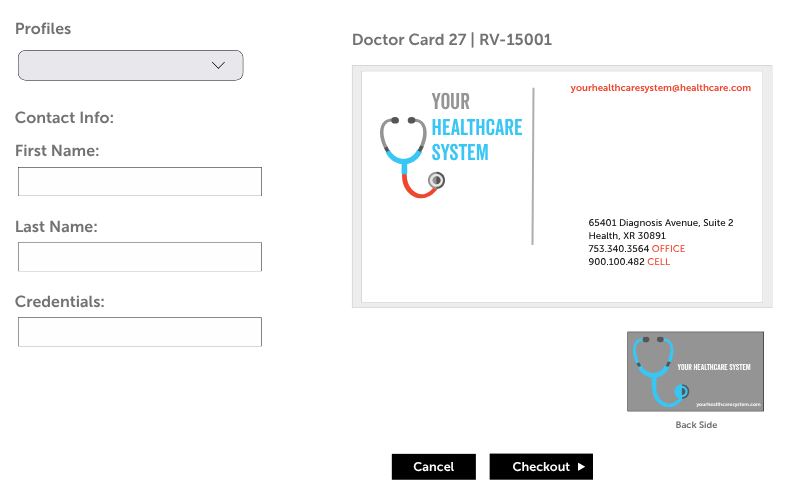
A storefront eliminates inconsistent branding and compliance challenges by creating secure, permission-controlled access to approved materials only. At Ironmark, we help healthcare systems build storefronts with consistency in mind from the start. Using their profiles, we set up specific guardrails, like how much a user can edit a product.
For example, we’ll build a product template for a variable item and outline exactly what users can edit, whether that’s a fill-in field, a drop-down menu, or another controlled customization option. This approach helps ensure only accurate, approved information is used while protecting against unauthorized edits, outdated messaging, and off-brand materials.
When every facility orders from the same ecosystem with pre-approved brand standards and compliant language, brand consistency and healthcare marketing compliance become more manageable.
Related: 5 Ways to Maintain Brand Consistency Across Locations
Managing Multiple Cost Centers Effectively
Healthcare accounting structures can be complicated with separate cost centers, blanket purchase orders, and complex approval hierarchies. Without centralized systems, reconciling those expenses becomes deeply manual and error prone.
Dave explains how some of his longstanding healthcare clients manage inventory and departmental chargebacks simply, “We have an optimized process where we issue cost center reports at the end of each month. Any department that has ordered inventory in that time period will be charged only for the amount that they use.” This simplifies and streamlines accounting.
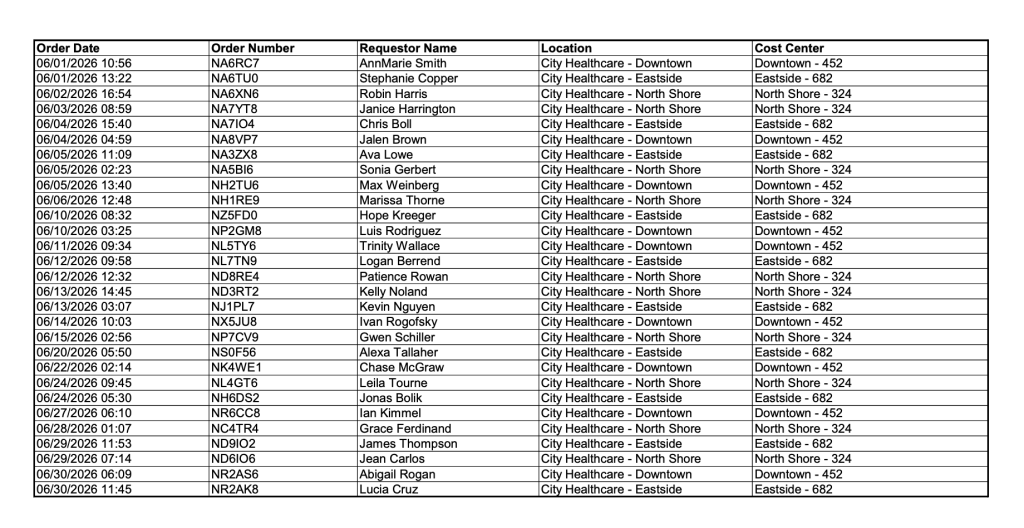
Storefronts can automate the process correctly from the start, with:
- Department-level billing
- Cost-center assignment
- Approval routing
- Budget visibility
- Reporting and reconciliation
This clear operational visibility often becomes one of the platform’s largest ROI drivers, providing a window into exactly what is spent across forms, marketing assets, promo items, and more.
Reducing Inventory Waste with Smarter Controls
Waste is another concern. Healthcare organizations have historically overproduced printed materials because ordering cycles were slow, and updates were difficult to manage. Concurrently, different departments and locations waste money by ordering items separately and not leveraging bulk discounts.
This approach can be costly and risky. Forms, compliance language, and operational materials change constantly, and warehousing hundreds of outdated forms creates compliance gaps.
So, many healthcare organizations are shifting toward hybrid inventory models that combine warehousing with print-on-demand production.
As Dave explains, “It doesn’t make sense to order 10,000 forms and put them on a shelf in a warehouse. Rather, everything is produced on demand, so revisions can be made as they come up. On-demand printing is increasingly popular.”
This strategy reduces obsolete inventory, storage cost, compliance risk, waste, and fulfillment delays. It also allows healthcare systems to respond faster when legal, clinical, or branding updates occur.
Ordering portals support best practices for healthcare asset management in medical facilities by improving version control and reducing unnecessary spending. But to be effective, your portal must be designed around how your organization operates, including whether you need an always-on ordering hub, a temporary pop-up storefront, or both.
Choosing the Right Healthcare Storefront Model
This is an important question to consider. The right structure depends on how your organization orders, manages, and distributes materials. For most teams, your decision comes down to two common models: always-on portals and pop-up storefronts.
Always-On Storefronts: The Operational Backbone
Always-on storefronts serve as long-term infrastructure for healthcare systems.
These portals support the daily operational needs of departments across the organization, including:
- Clinical forms
- Admissions materials
- Physician materials
- HR and recruiting assets
- Internal communications
- Marketing collateral
- Business cards
- Signage
- Promotional products and apparel
If your organization manages constant ordering and frequent changes, an always-on storefront can become indispensable. The organizations seeing the greatest success are building storefronts that scale alongside operational growth, rather than rebuilding systems every few years.
Pop-Up Storefronts: Ordering as Needed
While many organizations benefit from a permanent storefront, a pop-up storefront can often supplement specific seasonal needs. Fast, focused, and campaign-driven, pop-up storefronts accommodate clear timelines and defined ordering windows, making them ideal for:
- Employee appreciation campaigns
- Uniform ordering periods
- Recruitment campaigns
- Seasonal wellness initiatives
- National Nurses and Physicians Week campaigns
- Rebranding rollouts
- New facility launches
- Fundraising events
- Conferences and trade shows
These storefronts become highly organized temporary command centers. They work particularly well for inventory control and fast coordination of participation across facilities or regional teams.
Together, always-on and pop-up storefronts are built to handle big workflows. Yet some organizations miss that nuance.
The Biggest Mistakes Healthcare Organizations Make
Many organizations set themselves up for failure before they’ve even built their storefront, by:
- Thinking Too Small
Healthcare operations involve multiple departments, approval layers, budgets, facilities, and vendors, but it’s easy to treat an ordering portal like a simple procurement tool. That mindset limits what the storefront can actually solve. The real value comes when the portal is built to manage the full lifecycle of branded and operational materials.
So, successful organizations increasingly view the storefront as an entire healthcare asset management software platform that supports constant updates, tight compliance requirements, and urgent turnaround times.
Related: Best Practices for Storing Marketing Materials Across Multiple Locations - Failing to Identify Their Exact Needs
This is one of the places where the implementation process matters most. At Ironmark, so much of a successful implementation starts with making sure we thoroughly explore the challenges you’re facing. As we get into the conversation, we sometimes find that the problem can be solved in a different way than originally expected. So, we make sure that we thoroughly understand your perception of the challenge, then do a deep dive into your organization’s operations because that will drive how we build the store at the base level.
We also bring the right stakeholders into the conversation from the start, including Marketing, Communications, Procurement, Finance, IT, Compliance, Operations, and more.
This critical upfront information ultimately drives the portal’s design. A successful ordering portal should address your organization’s most important objectives. - Not Considering Operational Lag
If a department suddenly needs downtime forms because a system goes offline, waiting three weeks for fulfillment is simply not an option. You need to ensure your storefront strategy is efficient and resilient. To successfully support a healthcare organization, a storefront must have the ability to handle downtime and other fulfillment needs expeditiously.
Why Healthcare Organizations Partner with Ironmark
Healthcare storefronts are not generic ecommerce builds. They require deep understanding of compliance, operational workflows, fulfillment strategy, inventory management, and enterprise brand governance.
More than the software, a successful ordering portal offers superior customer service. No ordering portal can effectively serve healthcare brands’ needs without the supportive expertise of a real team.
At Ironmark, we’re all committed to excellent service. We’ve seen again and again what makes a branded digital ordering portal work, and we specialize in helping healthcare organizations design storefront ecosystems that simplify complexity, strengthen brand control, improve operational efficiency, and scale with organizational growth.
We follow the mantra that Dave espouses, “The bottom line is to make sure we have top-notch customer service…. I have great customer service reps that work behind the scenes of the portals. I can’t be successful unless I have successful people behind me to make it happen. Many of my customers have been with us for a very long time, and we take pride in getting them answers in a timely way and finding solutions that meet or exceed their needs, even when items are out of stock or the timing doesn’t seem like it will work. We figure it out.”
Healthcare organizations already have enough complexity to manage. With the tools and team designed to handle communication, compliance, and control, your storefront should streamline your business, and your success.