Highlights:
- Successful AI adoption requires cross-functional collaboration. An AI Council brings together different departments to evaluate opportunities, establish governance, manage risks, and align AI initiatives with business priorities.
- Sustaining progress requires more than enthusiasm. Clear ownership, executive support, dedicated resources, and defined responsibilities are essential to long-term success.
- Becoming AI-emergent requires a broader adoption framework that includes employee training, departmental champions, and ongoing support. The goal is to turn experimentation into practical improvements.
Experiment, govern, or scale? Every organization is trying to figure out its place in the age of AI.
You may be enthusiastically adopting new tools, cautiously testing the waters, fielding leadership questions, or still trying to separate legitimate opportunities from the daily flood of AI headlines, product launches, and predictions.
What Is an AI Council?
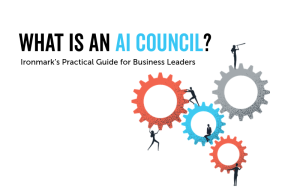
An AI Council is a cross-functional group that helps an organization evaluate, govern, and apply AI in practical ways. Think of it as a strategic forum that aligns experimentation with business priorities, risk management, policy, and broader AI governance and compliance needs.
Maybe counterintuitively, the most effective councils aren’t made up only of AI specialists. Rather, they’re composed of the people whose primary jobs are something else entirely: marketing, operations, technology, security, finance, HR, and other areas of the business that feel the impact of AI in different ways.
In our experience, that mix matters. A strong AI Council brings different perspectives into one room, so organizations can track what is happening in the AI landscape, where AI is already showing up in the business, and identify the use cases with the greatest potential impact.
Starting Checklist:
- Name an executive sponsor and someone to own the work
- Choose a few initial use cases
- Establish data-use rules
- Bring in cross-functional members
A successful AI Council will eventually need executive sponsorship, organizational buy-in, and clear ownership. Beyond evaluating tools, it can help to establish security policies, vendor reviews, training programs, and communication plans.
AI Councils are responsible for helping organizations move from AI curiosity to AI action. While they are not a fully fleshed AI adoption strategy on their own, they can become one of the first structures that makes a broader strategy possible.
Choosing to Embrace AI
At Ironmark, we realized early that AI wasn’t just another technology trend. It represented a fundamental shift in how work gets done. I remember telling our team that it’s coming. And we needed to know it.
We’re never going to be AI-native. We weren’t set up that way. But a lot of companies are going to be AI-obsolete if they resist change. We’re somewhere in the middle. We’re transforming the company–including the people, processes, and platforms within it– to leverage AI as effectively as we can.
That middle ground is what’s been called AI-emergent: organizations that weren’t built around AI initially, but are intentionally embracing it to optimize their work.
One of our first steps on that journey was creating an AI Council.
Why Ironmark Created an AI Council
Ironmark’s AI Council began in early 2023, shortly after the release of ChatGPT.
I had been following AI developments through Paul Roetzer’s Marketing AI Institute since 2019, and quickly recognized the potential impact AI would have on marketing, operations, and business performance. I remember connecting with one of my colleagues, who had a shared interest in AI’s future. We were doing cartwheels on November 30th, 2022 when ChatGPT came out, going back and forth about what it could do. That quickly turned into a bigger question. Who else would be interested?
We got approval from leadership to start the council right away. At the time, there was no budget, no dedicated AI team, and no established roadmap, just a growing realization that the company needed to learn. So, we started where many organizations do: with enthusiasts. Our council was a bunch of AI-watchers getting together, testing the tools, and sharing what we found.
From there, the team moved quickly to formalize the group. We developed a formal charter, established participation requirements, and created use-case documentation processes. We met regularly to share discoveries and opportunities. Supervisors approved participation, members contributed ideas, and the council became a place to explore how AI might impact different areas of the business.
The First Lesson: Someone Has to Own the Work
An AI Council can create something every organization needs at the beginning of AI adoption: momentum. It gives people a place to learn, share ideas, test tools, and begin turning curiosity into action.
But momentum alone is not enough.
At Ironmark, our original council revealed an unexpected challenge. Keeping up with AI quickly became a job in itself. As new tools, models, integrations, and capabilities emerged, even enthusiastic participants struggled to stay current while managing their day-to-day responsibilities. People wanted to participate, but the pace of change made it difficult to contribute consistently. It was a form of innovation fatigue.
That is something every organization should consider before creating an AI Council. Passion is a powerful starting point, but it cannot carry the work forever. Without ownership, structure, and clear expectations, even the most engaged team members can start to feel overwhelmed by the speed of change. Our first council taught us an important lesson. An AI Council is an excellent way to begin an AI transformation. But eventually, someone needs to own the work.
AI Often Reveals Problems Before It Solves Them
One of the most surprising discoveries from our AI journey had nothing to do with AI itself.
While documenting workflows and evaluating automation opportunities, our team uncovered significant differences in how estimating processes operated across locations.
One regional operation was significantly outperforming another, and our AI initiative helped uncover why: the two locations were using entirely different estimating processes. By sharing the more successful approach across regions, both operations were able to achieve comparable levels of success. This discovery delivered immediate operational value.
When you’re introducing AI, make sure not to overlook this lesson, as layering AI on a broken system or a broken process is just going to pull out all those weaknesses and magnify any problems. AI doesn’t magically fix inefficient processes. In fact, you’ll find that it often exposes them first.
That can be a great thing, because in many cases, visibility becomes the catalyst for meaningful improvement. It’s change management.
The Role of Training
The most important thing to remember when introducing AI tools to your organization?
Training should always come before rollout. We have been conducting AI training since late 2022, long before most organizations had formal AI education programs.
Initially, participation was voluntary. Over time, training became a foundational part of the company’s broader AI transformation strategy. Our experience reinforced the value of ongoing AI employee training and use case development so employees can connect the technology to real work with confidence.
Training doesn’t just improve adoption. Your organization benefits from increased confidence, reduced fear, better consistency, and a platform that helps employees understand how to deploy AI to support their work responsibly.
Establish the Support Systems Your AI Council Needs
An AI Council can help organizations move from scattered interest to more intentional action. But for AI adoption to take hold, the work eventually has to move beyond discussion and into the day-to-day realities of each team.
At Ironmark, that meant creating more structure around how people discover, test, and apply AI in practical ways.
That often starts with small wins. Rather than forcing large-scale transformation too early, organizations can build trust by helping teams find practical use cases that improve their work. That approach is now part of our broader enterprise AI adoption strategy, because responsible scaling starts with momentum.
As our approach evolved, we added dedicated AI adoption support and began building an AI Champion program to connect departmental experts with the AI Council and adoption team. The goal is to keep AI grounded in real work. Subject matter experts are often best positioned to identify the right opportunities, while AI specialists can help shape those ideas into tools, processes, GPTs, agents, or other solutions. That is where specialists can bridge the gap between a promising use case and the technology that makes it usable.
For companies just starting out, the lesson is simple. An AI Council does not have to solve everything on its own. Its real value is helping the organization create a bridge between curiosity, governance, and practical adoption.
Related: What’s Changing in Marketing with AI in 2026, and How to Operationalize It
What Business Leaders Should Know Before Starting an AI Council
Every eIf your organization is considering an AI Council, here’s my advice: treat it as one component of a broader AI adoption framework. Start with governance, invest in training, and focus on business problems where AI can build trust and deliver measurable results.
- Build executive support.
- Create governance guidelines.
- Invest in training.
- Focus on real business problems.
- Most importantly, recognize that enthusiasm alone will only take you so far.
If you really want to become an AI-emergent company, make sure to funnel resources behind it, whether it’s investing in tools, carving out new roles, bringing on expert team members, or taking the time to train your organization properly.
Related: The AI Readiness Assessment Framework for Marketing Teams: Where’s Your Company?
An AI Council is Only a Starting Point
The organizations seeing the greatest success with AI are building a culture that’s ready to evolve alongside it.
At Ironmark, we’re learning that adapting takes more than introducing new tools. It takes investing in people, rethinking processes, and being willing to change how the business operates. That work will help determine how competitive we remain in the years ahead. We’re doing it now. Are you ready to join us?